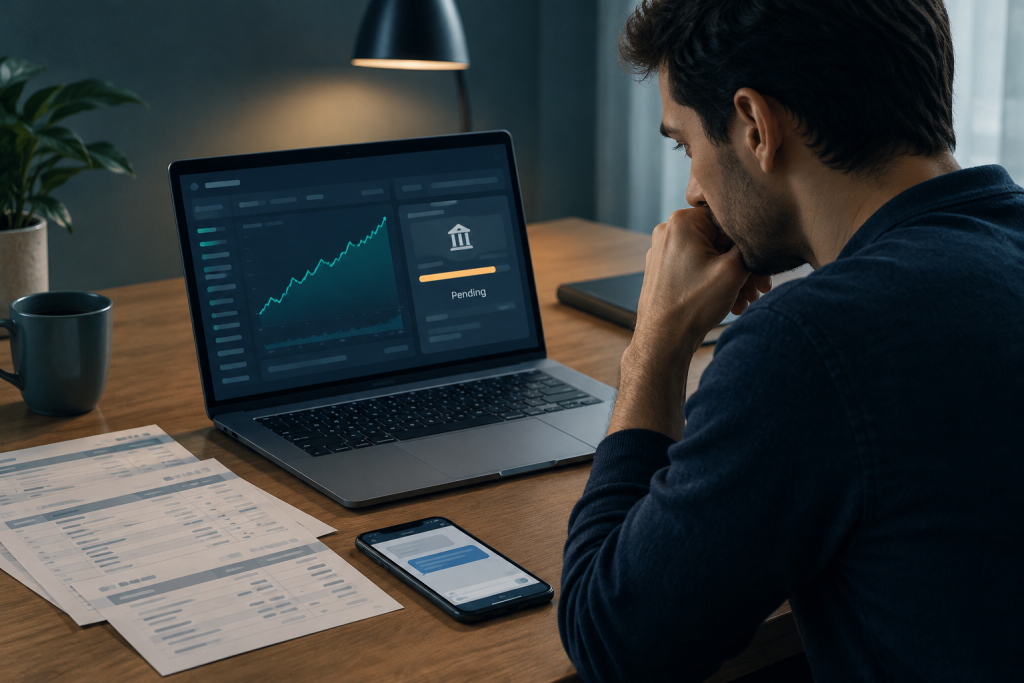
A trading account showing profits is not proof that those profits exist. The harder test is whether you can verify who holds your money, check the transactions independently and withdraw funds under terms disclosed before you deposited.
If a platform blocks your withdrawal and demands another deposit to release it, stop sending money while you investigate. A delayed payment does not automatically prove fraud. But a rising balance, an unverifiable operator and repeated demands to “unlock” your funds form a warning pattern that deserves immediate action.
The aim is to separate evidence from the platform’s own claims. A dashboard, account statement and helpful support agent may all come from the same untrustworthy operator.
How a Fake Trading Platform Makes Profits Look Real
A fraudulent platform can display an account balance without holding the corresponding assets. Charts, order histories and profit figures are information on a screen. They do not independently establish that your orders reached a market or that money remains available for withdrawal.
Early payments can make the deception harder to spot. Fraudsters sometimes let customers withdraw a small amount, then encourage much larger deposits. App availability is not proof of legitimacy either: fraudulent investment activity can operate through apps available in familiar stores. The joint investor alert on relationship investment scams documents manipulated account information, fake profits and withdrawals used to build trust.
Consider a hypothetical account. You deposit $1,000, see the balance rise to $1,650 and successfully withdraw $100. You then add $9,000. That first payment proves only that $100 reached you, not that the remaining balance exists or that the operator will release it.
Apply the same distinction to promotional evidence. A mentor’s screenshot is not an independent account audit. Check the supporting records rather than judging whether the image looks convincing; our guide to checking a WhatsApp trading mentor’s profit screenshots covers that separate problem.
A claim about automated trading does not change the test. Whether the profits supposedly come from a human analyst or software, the money and operator still need independent verification. Promises of effortless income deserve extra scrutiny, particularly with AI trading bots advertising guaranteed daily returns.
Withdrawal Warning Signs That Deserve Immediate Attention
The strongest warning is not that support takes a day to reply. It is that access to your existing money depends on sending more money, especially when the condition appeared only after you requested a withdrawal.
The FBI’s investment fraud guidance describes platforms displaying lucrative returns before freezing accounts and demanding supposed taxes or fees. A previous successful withdrawal does not cancel out that warning.
| What the platform says | What to check |
|---|---|
| “Pay tax before we release your profits.” | Independently verify the claimed obligation and recipient. Do not treat an invoice or official-looking letter as proof. |
| “Deposit a refundable security payment.” | Ask for the original contractual basis and an explanation of why withdrawal requires a fresh transfer. |
| “Upgrade your account to withdraw.” | Check whether this condition existed before your deposit and whether it applies to your original funds. |
| “The payment is approved, but another fee has appeared.” | Preserve each demand. Changing conditions make the promised release less credible, not more. |
A payment deadline should not replace verification. If support says the balance will disappear unless you pay within hours, do not let the countdown decide for you. Ask someone outside the investment to review the records.
Tax demands require particular care because they borrow authority from a real obligation. The issue is not whether investments can create tax liabilities; it is whether this operator’s demand is genuine. Use the separate guide on brokers demanding tax payments before releasing withdrawals for that assessment.
Verify the Operator, Not Just Its License Number
Start with the legal entity named in your account agreement. Record its full name, claimed registration number, regulator and contact details. Then locate the regulator independently rather than following a link supplied in a chat.
A matching registration number is not enough. Someone impersonating a registered firm can copy genuine details. Compare the firm and representative against official records, then contact the genuine business through independently verified channels. FINRA’s broker imposter scam factsheet recommends checking supplied registration information directly and comparing the associated firm and contact details.
Ask the genuine firm whether it operates the exact domain you used and whether your named contact works there. Do not accept confirmation from another person introduced by the same account manager. That is another claim, not another check.
The distinction matters enough to treat separately: clone brokers using a real company’s name and license number can look convincing precisely because part of their paperwork is genuine.
Use the register appropriate to the claimed service. For US futures and retail forex checks, the CFTC’s registration and background checking resource directs readers to NFA BASIC. Registration requirements vary by activity, so a missing entry needs investigation rather than an automatic verdict. A registration record also does not guarantee that an investment is safe.
If the operator claims overseas authorization, verify that claim with the named regulator. Do not assume that an overseas registration permits every product or authorizes business with customers in your location.
Separate a Genuine Withdrawal Issue From a Payment Trap
Not every displayed balance represents cash available to withdraw. Separate the account’s total value, open positions, completed trades and withdrawable cash. Ask support which figure your withdrawal request uses and what restriction applies to the difference.
Settlement is one legitimate distinction. Most US broker-dealer securities transactions subject to the standard settlement rule settle one business day after the trade, known as T+1. That does not promise immediate arrival in an external bank account. The SEC’s settlement cycle guidance sets out the rule’s scope and exceptions.
Identity requests and fees also need context. Genuine brokers request identifying information, and account agreements can include wire or transfer charges. The SEC bulletin on opening a brokerage account lists common identification requests and account fees. Their existence means “any fee proves fraud” is too broad a rule.
The practical question is whether the explanation is consistent, documented and independently verifiable. Request the relevant clause from the agreement you accepted, the amount affected and the remaining steps. Where a completion date cannot be given, ask what can be explained about the process.
Do not send further identity documents until you have verified the recipient. A request for identification does not make an operator legitimate, just as a request for identification is not automatically fraudulent.
Bonus conditions require another distinction. Identify whether a restriction concerns promotional credit, profits or your deposited money. Ask for the original terms and calculation rather than accepting a new turnover figure in chat. Our article on binary options bonus turnover requirements examines those restrictions in more detail.
Audit the Money Trail Outside the Dashboard
Build a simple record using documents you control: bank statements, card transactions, exchange withdrawal records and payment receipts. Compare each payment with what the platform credited to your account.
For every transfer, record the date, amount, currency and recipient. Note whether the recipient matched the business you believed you were paying. Where names differ, preserve the operator’s explanation instead of filling in the gap yourself.
For cryptocurrency, distinguish the purchase from the onward transfer. Buying coins through a genuine exchange does not verify the destination to which you later sent them. When reporting the incident, explain both stages clearly.
A hypothetical calculation shows why this matters. Suppose you sent $8,000, received $200 back and now see $47,000 on the platform. Your recorded net outflow is $7,800. The displayed balance is a separate, unverified claim. If support demands another $4,700, that is a new payment decision, not evidence that $47,000 awaits release.
Keep records of claimed profits, but do not let those figures determine how much more you are willing to risk.
What to Do When You Suspect the Platform Is Fake
Stop additional payments and contact your payment provider
Do not make another deposit to test whether the withdrawal works. Contact the bank, card issuer, payment service or cryptocurrency exchange involved through its official channels. Explain that you suspect investment fraud and ask what action is still possible.
The FTC’s steps for people who paid a scammer recommend contacting the payment provider immediately and requesting a reversal or refund where possible. Recovery is not guaranteed, but waiting for the platform to finish inventing conditions is not a useful alternative.
Describe the transaction accurately. If you authorized a transfer because someone deceived you, say that. If you bought cryptocurrency and then sent it elsewhere, identify the onward transfer rather than describing the original purchase as something you never authorized.
Preserve evidence without paying for access
Save available records before closing accounts or deleting conversations. Do not send more money, install another app or grant remote access just to obtain a statement.
- Capture the platform’s exact address, account identifier and displayed balance.
- Save withdrawal requests, status messages, fee demands and payment instructions.
- Export conversations and retain email addresses, phone numbers and usernames.
- Keep agreements, statements, receipts and promotional promises.
- For crypto transfers, preserve wallet addresses, the network, amounts, timestamps and transaction hashes.
Keep original files where possible and create a dated timeline. Separate what you personally verified from what the operator told you. That makes the account easier for a bank, investigator or adviser to assess.
For cryptocurrency cases, the FBI’s reporting guidance for cryptocurrency scam victims identifies transaction details as especially useful and directs victims to report promptly to IC3 or a local FBI field office. Include the destination addresses and transaction hashes, not just screenshots of the supposed trading profits.
Protect accounts and involve someone independent
Change passwords you shared or reused, starting with your email and financial accounts. Enable two factor authentication. If you granted device access, stop using that access arrangement and get help from a trusted technical provider to check the device.
Tell a trusted person what happened. Ask them to review the payment history with you, not to negotiate with the platform. An outside reader can help separate documented facts from promises, particularly when the displayed balance makes stopping feel like abandoning money.
Report the conduct to the relevant financial regulator as well as the appropriate fraud reporting authority. Keep confirmation numbers and copies of submissions. If the platform turns out to be a verified firm with a contractual dispute rather than a fabricated operation, those records will still help you pursue its formal complaints process.
Do Not Let a Withdrawal Scam Become a Recovery Scam
Treat an unexpected offer to retrieve the money as a new proposition requiring independent checks. Knowledge of your loss does not establish authority: someone contacting you may already have details from the earlier fraud.
Recovery scammers can impersonate government agencies, law firms or consumer organizations, then demand payment before releasing supposed recovered funds. The FTC warning on refund and recovery scams describes this follow-up approach and warns against unsolicited recovery offers requiring advance payment.
Verify any claimed organization through contact details you find independently. A demand for cryptocurrency to “activate” a refund should not receive special treatment because the sender uses legal language or displays a badge.
Our guide to crypto recovery scammers targeting trading fraud victims covers that second approach. For now, keep your decisions grounded in the records you can verify. You do not need to prove every part of the fraud before refusing another payment.